
Navigating Dayton Auto Insurance for Commuters and I‑675 Corridor Traffic
Smarter Auto Coverage for Dayton Commutes: An In-Depth Look
Driving in and around Dayton differs substantially from traveling on lightly used rural roads. For commuters who regularly traverse I-675, I-70, I-75, or US-35, the daily round trip is embedded in a complex system of traffic density, regional weather variability, and roadway design characteristics. Peak-hour congestion, construction seasons, and Ohio’s rapidly changing weather jointly increase the probability of collisions, glass damage, and severe crashes. In an environment where vehicles travel at higher speeds in close proximity, often amid frequent lane changes and heavy truck traffic, exposure to loss events increases measurably.
Accordingly, auto insurance for Dayton-area drivers should be structured to reflect actual patterns of use, roadway environments, and local risk characteristics rather than only the make and model of a vehicle. Decisions regarding liability limits, physical damage deductibles, and supplemental coverages can materially influence financial outcomes following a loss. They also interact with rating variables that determine monthly premium outlays. This article provides a more thorough, academically oriented exploration of commuter patterns in the Dayton region, risk dynamics along the I‑675 corridor and adjacent routes, the way insurers conceptualize and price these risks, and practical yet analytically grounded steps drivers can take to better align coverage with exposures while managing overall cost.
I. Understanding Dayton Traffic Risks Along I‑675
I‑675 functions as a critical circumferential connector within the Dayton metropolitan area. It links suburbs such as Beavercreek, Centerville, and Fairborn to regional employment centers, Wright-Patterson Air Force Base, Wright State University, and substantial retail and commercial complexes. This corridor experiences a heterogeneous traffic mix that typically includes:
- Local commuter traffic
- Regional and inter-regional through traffic
- Commercial vehicles and delivery fleets
- Occasional long-distance travelers unfamiliar with local patterns
From a risk analysis standpoint, several structural and operational characteristics of I‑675 and its intersecting routes contribute to elevated collision probability and severity:
1. Complex Interchanges
Interchanges where high-volume ramps merge with mainline segments, particularly near major shopping centers or office parks, create conflict points. Merging and diverging maneuvers at differential speeds are associated with elevated rates of sideswipe and rear-end collisions. Limited acceleration or deceleration lanes, short weaving sections, and high ramp volumes further compound this risk.
2. Recurrent Congestion and Stop-and-Go Conditions
During morning and evening peak periods, recurrent congestion leads to stop-and-go traffic and frequent micro-braking events. In such conditions, a brief lapse in attention or an unexpected lane change can precipitate multi-vehicle rear-end collisions. Even seemingly minor crashes can involve multiple parties, producing claim severities higher than those observed on lower-speed local roads.
3. Lane Utilization and Speed Variability
Sections where on-ramps feed directly into faster-moving lanes with limited merging distance can produce speed differentials that reduce drivers’ reaction time. When this is combined with high lane-change frequency, common among commuters attempting to bypass queues, the likelihood of sideswipe and merging collisions increases.
4. Construction Zones
Construction and maintenance zones introduce narrowed lanes, frequent lane shifts, temporary barriers, and variable speed limits. From a risk-management standpoint, such environments typically exhibit:
- Reduced lateral clearance for evasive maneuvers
- Elevated risk of sideswipes and single-vehicle barrier impacts
- Increased potential for debris-related losses (tire damage, glass damage, undercarriage impacts)
Seasonal and Transitional Hazards
In the Dayton region, late winter and early spring represent transitional periods with distinctive risk profiles. Following the winter, pavement conditions often deteriorate, and residual winter-weather effects persist even as temperatures rise.
Common spring-related hazards include:
- Residual slick surfaces or black ice on elevated structures (bridges, overpasses) during early morning hours when temperatures briefly dip below freezing
- Potholes and pavement failures resulting from freeze-thaw cycles, capable of damaging tires, wheels, and suspension components at highway speeds.
- Heavy or sudden rainfall that can overwhelm drainage capacity, producing localized ponding and elevating the risk of hydroplaning, especially in rutted lanes or near lane-change areas.
- Morning fog in low-lying areas near rivers and fields, reducing sight distances and complicating high-speed merging and braking.
Empirically, these conditions tend to increase both crash frequency (more events) and severity (higher-impact collisions or more extensive vehicle damage). A single deep pothole encounter can bend rims or blow out tires, potentially causing loss of control incidents. From a coverage perspective, these risk factors underscore the importance of aligning policy choices with real, recurrent roadway exposures rather than a hypothetical “average” use case.
II. How Commuting Habits Shape Auto Insurance Premiums in Dayton
Insurers operationalize risk by converting observable attributes, both of vehicles and of driver behavior, into rating variables that correlate with claim frequency and severity. Vehicle use patterns are central to this process. Accordingly, nearly all personal auto applications inquire about how each vehicle is used (pleasure, commute, business, or commercial) and the estimated annual mileage.
Key Commuting Variables
For Dayton-area drivers, the following factors are typically material to rating decisions:
- Average round-trip commuting distance to work or school
- Estimated annual mileage (e.g., 6,000, 12,000, 15,000+ miles/year)
- Frequency of highway use, including I‑675, I‑70, I‑75, and US‑35
- Time-of-day distributions (rush-hour exposure vs. off-peak driving)
From an actuarial standpoint, greater exposure, measured in both miles driven and time spent in high-risk environments, generally correlates with increased claim frequency. Thus, a motorist who spends an hour per day in dense I‑675 traffic is treated differently than an occasional local driver whose trips are shorter and at lower speeds.
Data Collected for Rating Purposes
To price auto insurance in Dayton, insurers generally gather a core set of data elements, including but not limited to:
- Garaging and residence ZIP codes (home location)
- Workplace or primary use ZIP code (commute destination)
- Estimated annual mileage, sometimes subdivided by use type
- Where the vehicle is parked overnight (garage, driveway, street, lot) and during the day (secured garage, employer lot, street parking, etc.)
- Motor vehicle record data (accidents, violations) and prior insurance history (claims, lapses)
Accuracy and Misrating
From a compliance and claims-handling perspective, accurately representing vehicle use is critical. Understating commute mileage or misclassifying a daily-use commuter vehicle as “pleasure only” may appear minor to the policyholder but can constitute misrating. Potential consequences include:
- Premium adjustments upon review or renewal
- Re-underwriting of the risk, possibly affecting eligibility with a given carrier
- Complications during claim investigations if usage patterns materially deviate from the application representations
A prudent approach is to quantify commute distance using mapping tools, maintain a reasonable estimate of annual mileage, and provide these figures to an insurance professional. This enables appropriate carrier placement, often with carriers whose pricing models align more favorably with specific usage profiles, and may also reduce the likelihood of adverse surprises at renewal or claim time.
III. Core Auto Insurance Coverages for Dayton Commuters
Ohio Minimum Requirements and Their Limitations
Ohio law requires drivers to maintain minimum liability coverage, expressed as per-person, per-accident, and property-damage limits. While specific statutory minimums can change over time, they are generally calibrated to a basic legal threshold rather than to the potential losses arising from serious multi-vehicle highway collisions.
On high-speed corridors such as I‑675, I‑70, I‑75, and US‑35, the collision environment includes:
- Vehicles of high replacement value (late-model SUVs, trucks, hybrids, and EVs)
- Commercial vehicles and trucks capable of inflicting substantial damage
- Multi-vehicle chain-reaction crashes triggered by sudden slowdowns or lane conflicts
In such scenarios, cumulative injury and property damage costs can readily surpass statutory minimums. For many Dayton commuters, minimum limits function as a legal floor, not an adequate risk-management benchmark.
Key Coverages and Their Functions
1. Bodily Injury Liability
Covers medical expenses, lost wages, and related damages for other parties when the insured is legally responsible for a crash. Adequate limits are critical for asset protection and future income preservation, particularly for individuals with significant savings, home equity, or professional income.
2. Property Damage Liability
Pays for damage to others’ property, typically other vehicles but also structures, signage, and other property. On a congested highway, a multiple-car incident or a collision involving a commercial vehicle can easily exceed low property damage limits.
3. Uninsured and Underinsured Motorist (UM/UIM)
These coverages respond when the at-fault driver has no insurance or insufficient limits to compensate injured parties. Given that a non-trivial portion of the driving population may be uninsured or underinsured, UM/UIM is often a central component of a robust commuter-focused policy. It effectively functions as a protective layer mirroring the liability coverage you would hope the at-fault driver carried.
4. Collision Coverage
Applies to damage to the insured vehicle resulting from collisions with other vehicles or objects, regardless of fault (subject to the policy’s terms and deductibles). For Dayton commuters who rely on a single primary vehicle to reach work, collision coverage is often essential to mitigate the financial impact of at-fault or partially at-fault incidents.
5. Comprehensive Coverage
Responds to non-collision losses, including theft, vandalism, fire, hail, certain weather-related damage, and most glass damage. For vehicles regularly parked in open lots near major corridors or large employment centers, comprehensive coverage addresses risks that are not tied directly to driving behavior.
6. Medical Payments Coverage (MedPay)
Provides limited coverage for medical expenses for the insured and passengers, regardless of fault. This can be particularly useful in single-vehicle incidents (e.g., sliding into a guardrail on a slick ramp) or low-severity collisions where health insurance deductibles and co-pays would otherwise fall on the insured.
Ancillary Coverages Highly Relevant to Commuters
1. Rental Reimbursement
Covers the cost of a temporary replacement vehicle while the insured car is being repaired following a covered claim, up to day and total limits. For commuters who rely on their vehicle to maintain income, this coverage can mitigate indirect costs such as lost wages, emergency rideshare use, or the logistical burden of securing alternative transportation.
2. Roadside Assistance
Provides services such as towing, battery jump-starts, fuel delivery, and lockout assistance. For drivers traveling long stretches of I‑675 or other highways, roadside assistance can reduce both safety risk (time spent stranded at the roadside) and out-of-pocket expenses.
3. Towing Coverage with Realistic Limits
In some policies, towing is offered with standalone limits. Ensuring that these limits reflect the actual cost structure of local towing and storage, particularly from highway shoulders or after-hours retrievals, is important. Underestimating these costs can lead to significant uncovered expenses.
IV. Balancing Cost and Protection for I‑675 Corridor Drivers
The central optimization problem for most commuters is to achieve a risk-appropriate level of coverage while keeping premiums within budgetary constraints. Policy design involves a series of interrelated choices that can be conceptualized as adjustable levers.
1. Liability Limits
From a financial-planning perspective, liability coverage is typically not the ideal area to economize, especially for regular highway commuters. Higher liability limits offer greater protection against large judgments or settlements arising from severe collisions, multi-vehicle incidents, or crashes involving high-income claimants.
2. Deductibles for Collision and Comprehensive
Deductibles represent the insured’s retained risk, amounts the policyholder agrees to pay out-of-pocket before coverage responds.
- Raising deductibles generally reduces premiums.
- In practice, some commuters select a higher comprehensive deductible than collision if they view comprehensive losses (e.g., glass-only claims) as smaller or less disruptive than collision losses.
However, deductible decisions should be evaluated against liquid savings and risk tolerance. If a chosen deductible would be difficult to pay unexpectedly, the cost savings may not justify the financial strain during a claim.
3. Optional Endorsements and Features
Optional coverages such as rental reimbursement, enhanced towing, and expanded glass coverage often add modest incremental premium relative to their practical value during a loss. For a commuter whose income depends on consistent attendance at work, the indirect costs of being without a vehicle can exceed the direct repair costs. Evaluating these add-ons through the lens of income continuity and logistical resilience can be helpful.
Strategies to Manage Premiums Without Undercutting Protection
Dayton commuters often have access to several premium-moderation mechanisms that do not require sacrificing core protections:
- Bundling auto with homeowners or renters coverage under a single carrier to secure multi-policy discounts.
- Participating in safe-driver or telematics (usage-based) programs that monitor driving behavior (e.g., hard braking, nighttime driving) and may provide discounts to risk-conscious drivers.
- Leveraging multi-vehicle discounts when multiple household drivers maintain coverage with the same insurer.
- Maintaining a clean driving record and avoiding lapses in coverage, both of which are generally viewed favorably in underwriting and rating.
Within Ohio’s regulatory framework, insurers may also incorporate credit-based insurance scores as rating factors, within statutory constraints. While the exact algorithms are proprietary, maintaining overall credit health can, in many cases, support more favorable premium outcomes.
It is a misconception that all long-distance commuters must pay disproportionately higher premiums than low-mileage drivers. While commute exposure is a meaningful variable, insurers weight a composite of factors, including violation history, at-fault accidents, vehicle type, territory, and persistency with prior carriers. A commuter with longer mileage but excellent driving history and a standard vehicle may still qualify for competitive rates, particularly with carriers that price aggressively for preferred risks.
Independent agencies that regularly work within the Dayton market can help identify carriers that treat commute distance, telematics participation, and discount structures in ways that align with a given driver’s profile.
V. Local Dayton Factors That Affect Auto Insurance
Although Ohio’s statutory framework sets a baseline for auto insurance, local conditions within the Dayton region influence both risk levels and insurer pricing models.
1. Crash Density and Geographic Hotspots
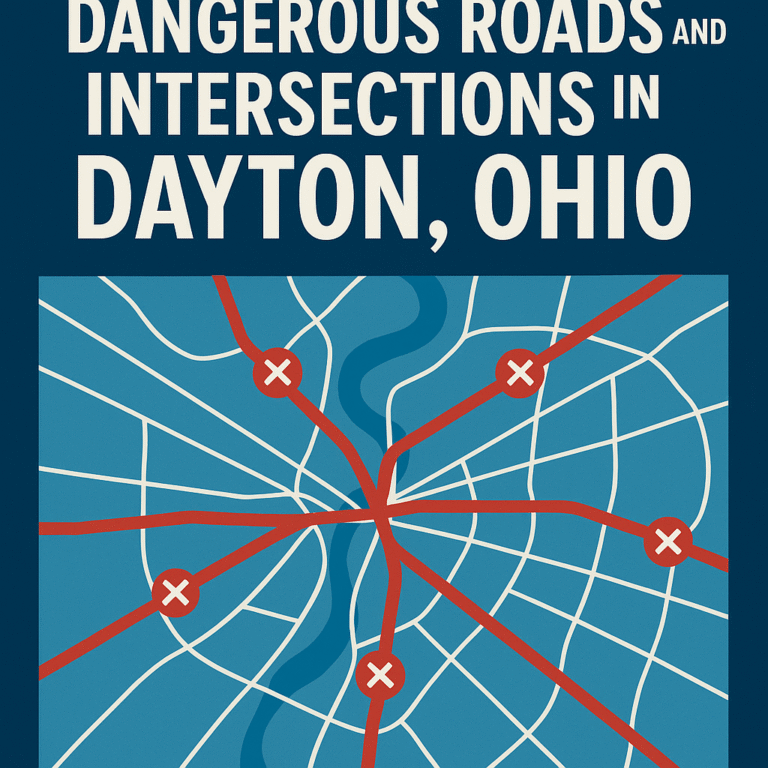
Insurers and transportation planners analyze crash-frequency data by corridor and intersection. In and around Dayton, higher crash densities near major interchanges, employer clusters, and retail complexes can signal elevated risk for vehicles garaged or frequently driven in those micro-territories. Insurers may incorporate such territorial variations into rating, even at the ZIP+4 or census-block level, depending on their segmentation strategies.
2. Theft, Vandalism, and Parking Environments
Vehicle theft and break-in rates vary by neighborhood and parking type. Common commuter parking scenarios include:
- Structured parking garages in downtown or campus-adjacent areas
- Surface lots near major employers or park-and-ride locations
- Residential driveways or on-street parking in suburban neighborhoods
A vehicle parked overnight in a secure garage typically presents a different risk profile than one parked in an open lot near a highway interchange. Disclosing garaging and routine parking environments enables more accurate underwriting and can help shape recommendations on comprehensive coverage and deductibles.
3. Repair Market Characteristics
The availability of qualified repair facilities and regional labor rates also influence claim severity. In the Dayton area, the growing prevalence of vehicles equipped with advanced driver-assistance systems (ADAS), such as automatic emergency braking, lane-keeping assist, and blind-spot monitoring, has increased the complexity of many repairs. What once constituted a relatively simple bumper repair may now involve:
- Sensor replacement or recalibration
- Camera realignment
- Software updates and system diagnostics
These added steps contribute to higher repair costs and longer cycle times, factors that insurers must account for in pricing. From a policyholder’s standpoint, understanding that minor collisions can produce unexpectedly high repair bills helps contextualize the need for adequate collision coverage and appropriate deductibles.
VI. Seasonal Driving Challenges for Spring Commutes in Ohio
Springtime in Ohio, particularly from late March through early May, presents a distinct cluster of hazards for commuters along I‑675 and associated corridors.
Meteorological and Environmental Factors
Typical spring challenges include:
- Residual Icing and Temperature Variability: Rapid temperature swings can produce early-morning black ice on bridges, ramps, and shaded segments, complicating braking and cornering at highway speeds.
- Intense Rainfall Events: Convective storms or prolonged rainfall can create standing water in rutted lanes or near drainage inlets. At highway speeds, hydroplaning risk escalates substantially, especially when tire tread depth is marginal.
- Fog and Reduced Visibility: Morning fog near river valleys or open fields can reduce sight distance just as traffic volumes build, impairing perception of brake lights and lane-change signals.
- Daylight Shifts: Daylight saving time alters ambient lighting conditions during typical commute windows, possibly increasing nighttime or low-light driving exposure.
Roadway and Construction-Related Factors
Spring is also a primary period for roadway maintenance and construction in Ohio. As crews repair winter damage and initiate longer-term projects, commuters may experience:
- Potholes, pavement heaves, and differential settlement near lane edges
- Temporary lane shifts with reduced shoulders and narrower lanes
- Frequent changes in signage, speed limits, and traffic patterns
- Presence of loose gravel, small rocks, and construction debris
These conditions can culminate in a range of claim-generating events, including:
- Cracked or shattered windshields from rock strikes
- Tire blowouts and wheel damage from deep potholes
- Suspension and alignment issues from repeated impacts
- Minor sideswipes or barrier contacts within constrained work zones
Coverage Interactions with Spring Hazards
Understanding how different coverages respond to spring-related losses is important:
- Collision Coverage: Often applies to damage caused by hitting a pothole if the incident is treated as a collision, as well as to single-vehicle impacts with guardrails or barriers.
- Comprehensive Coverage: Typically applies to non-collision events such as falling debris, certain weather-related damage, and most glass-only losses, including windshield cracks from rock impacts.
- Special Glass Endorsements: Some carriers offer reduced or zero deductibles for glass repair or replacement. For commuters who frequently travel on construction-affected routes, these endorsements can materially reduce out-of-pocket costs for recurrent glass claims.
- Medical Payments Coverage: Can assist with medical costs resulting from single-vehicle incidents, such as sliding off the roadway due to black ice, even when no third-party liability is involved.
Because seasonal patterns and construction schedules evolve annually, periodic coverage reviews are prudent. If, for example, a given stretch of I‑675 is undergoing multi-year reconstruction that elevates glass and tire claims, it may be appropriate to reassess deductibles, glass coverage options, and roadside assistance limits.
VII. Practical Steps to Optimize a Dayton Auto Policy
Transforming these conceptual considerations into an optimized policy can be approached systematically. A structured review process enhances the quality of discussions with an insurance professional.
1. Document Actual Commuting Patterns
- Measure round-trip distance for a typical workday using reliable mapping tools.
- Record the number of commuting days per week (e.g., hybrid work arrangements vs. five days on-site).
- List primary routes (I‑675, I‑70, I‑75, US‑35, or local arterials) and approximate travel times.
2. Examine the Current Policy Declarations Page
Identify and note:
- Bodily injury and property damage liability limits, including whether they are expressed as split limits (e.g., 100/300/100) or combined single limits (CSL).
- The presence and limits of uninsured and underinsured motorist coverage.
- Collision and comprehensive coverage status and associated deductibles.
- Optional coverages in force, such as rental reimbursement, towing, roadside assistance, or glass-specific endorsements.
3. Articulate Real-World Risk Scenarios
For many Dayton commuters, recurring risk scenarios may include:
- Rear-end collisions in stop-and-go traffic near interchanges or bottlenecks.
- Lane-change incidents where high speeds and limited gaps create sideswipe risks.
- Windshield damage from construction debris or loose gravel.
- Tire and wheel damage caused by potholes or deteriorating pavement in spring.
Explicitly linking these scenarios to coverage components (e.g., collision vs. comprehensive vs. UM/UIM) helps ensure that the policy is designed to address the most probable and impactful exposures.
4. Prepare Focused Questions for an Insurance Professional
When consulting with an independent agent or broker familiar with the Dayton and I‑675 corridor environment, consider questions such as:
- Given my commute distance, typical routes, and financial situation, what liability limits would you recommend and why?
- What UM/UIM limits are appropriate relative to my liability limits and health insurance coverage?
- Would a usage-based or telematics program likely be advantageous given my driving times and habits?
- Are my current deductibles aligned with the vehicle’s age, expected remaining life, and my savings?
- Are there carrier-specific endorsements (e.g., expanded glass coverage, enhanced rental allowances) that are particularly beneficial for commuters in this region?
5. Establish a Regular Review Cadence
A reasonable review schedule is at least annually, or upon any of the following changes:
- New job or material change in work location or commute distance.
- Acquisition or disposal of a vehicle, especially if the new vehicle has different safety or repair-cost characteristics.
- Addition of a new household driver, such as a newly licensed teen.
- Change in garaging or parking conditions, such as moving from street parking to a secured garage or vice versa.
Updating the insurer and agent proactively when substantial changes occur supports accurate pricing and can reduce friction in future claims.
VIII. Partnering With Local Expertise for Evidence-Based Decisions
Auto insurance in Dayton is not merely a matter of satisfying a statutory minimum requirement. For commuters regularly navigating the I‑675 corridor and adjacent highways, it is an exercise in matching coverage to a specific, empirically observable risk environment characterized by:
- Dense, high-speed traffic
- Recurring construction and maintenance zones
- Seasonal and transitional weather hazards
- Evolving vehicle technologies and repair cost structures
Local independent agencies that work with multiple regional and national insurers are often positioned to observe patterns that are less visible to individual drivers, for example, where minor collisions frequently occur, which corridors tend to generate higher frequencies of glass or tire claims, and how different carriers manage roadside incidents, repair authorizations, and rental timelines.
By leveraging such localized, data-informed insight, Dayton commuters can move beyond generic policy templates and instead pursue coverage configurations tailored to their actual driving environment, financial objectives, and risk tolerance. This approach situates auto insurance not merely as a regulatory obligation, but as a structured component of personal risk management, designed to function reliably across seasons, construction cycles, and the evolving realities of the I‑675 commute.
Protect Your Drive With Coverage Tailored To Dayton Drivers
If you are ready to make sure your vehicle is properly protected, we are here to help you find the right fit. At Ingram Insurance Group, our local team will walk you through your options so your policy matches how and where you drive. Start comparing personalized choices for auto insurance in Dayton today and see how straightforward better coverage can be.