Homeowners Insurance for the Huffman Historic District in Dayton, Ohio
The Huffman Historic District in Dayton, Ohio, is one of the city’s most architecturally significant neighborhoods—an 85-acre enclave of brick mansions, wood-frame Victorians, and 19th-century streetscapes that has changed remarkably little since the 1870s. For homeowners, this stability is both a gift and a challenge. Owning a home in Huffman means stewarding an irreplaceable piece of Dayton’s history, but it also means managing insurance exposures that are more complex than those associated with contemporary construction. This article provides a rigorous, academically styled overview of the key insurance issues facing Huffman homeowners and offers a structured framework for aligning coverage with the realities of historic property ownership.
If you are looking for a broader foundation before diving into neighborhood-specific details, you may find it helpful to review our general guide on how homeowners insurance works in Ohio, which this article will build upon in a more specialized way.
The Huffman Historic District: Context and Built Environment
The Huffman Historic District is located in Dayton’s Historic Inner East, roughly bounded by East Third Street, Hamilton, Van Lear, and Beckel Streets—approximately one mile east of downtown. :contentReference[oaicite:1]{index=1} The neighborhood was largely developed between the 1860s and 1890s as a streetcar suburb catalyzed by banker and real estate developer William P. Huffman. :contentReference[oaicite:2]{index=2} During its formative decades, Huffman accommodated a broad socioeconomic spectrum—from laborers and tradespeople to merchants and executives, a diversity still evident in the range of lot sizes and building scales.
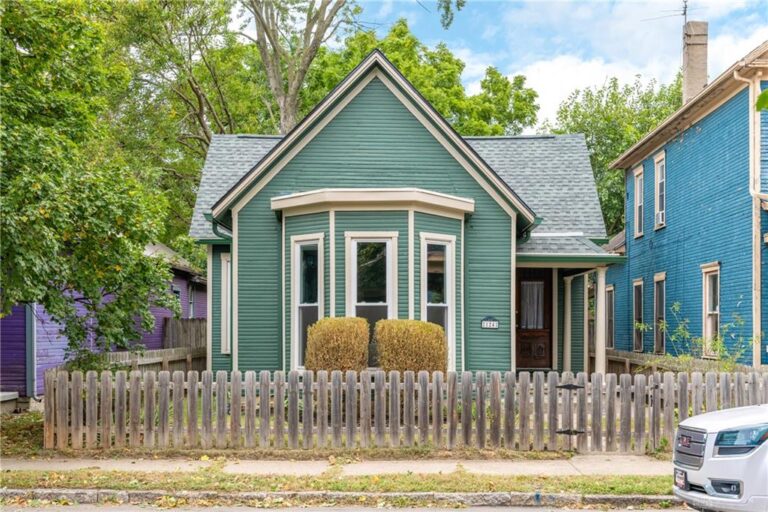
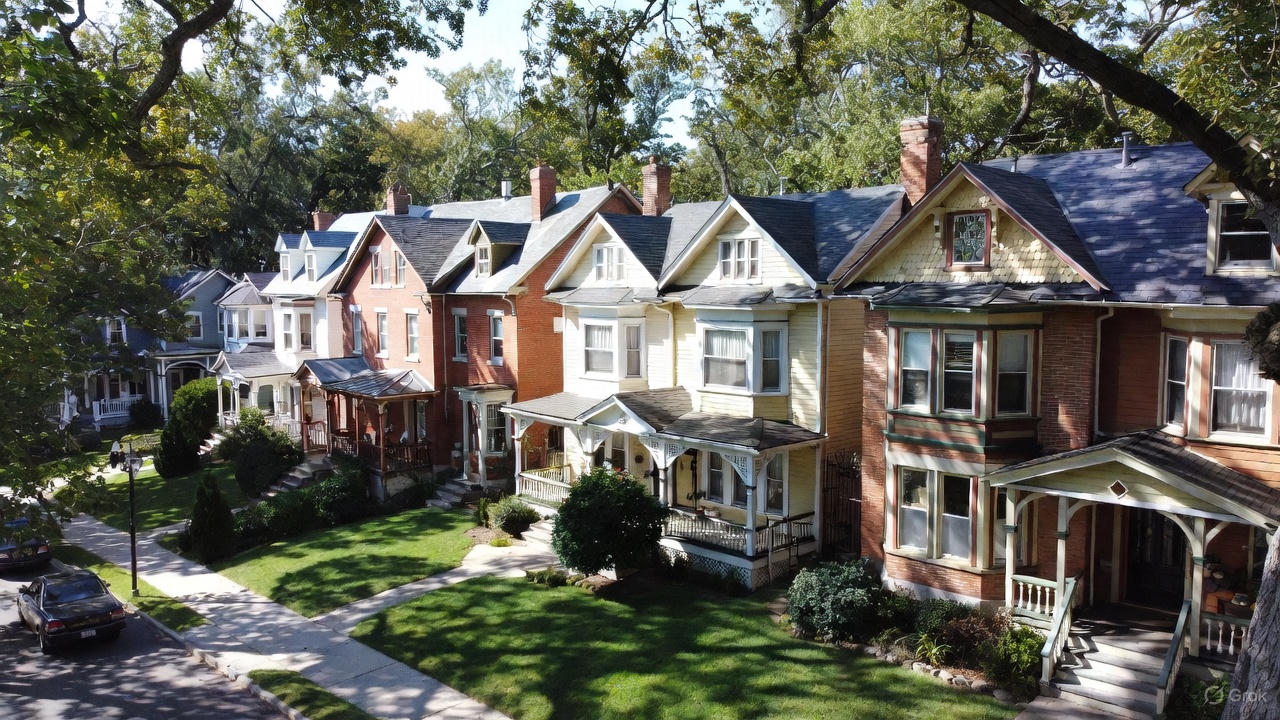
Architecturally, Huffman is notable for its concentration of late-19th-century styles, including Italianate, Queen Anne, Victorian Gothic, and related Victorian-era idioms. :contentReference[oaicite:3]{index=3} Many streets feature a juxtaposition of substantial brick residences and highly articulated wood-frame Victorians, often with complex rooflines, towers, turrets, and ornate millwork. The district’s inclusion on the National Register of Historic Places in 1982 and its local historic district status since 1981 reflect both the quality and the integrity of its building stock; at the time of designation, 663 of 668 buildings were considered contributing structures—a remarkably high proportion by national standards. :contentReference[oaicite:4]{index=4}
From an insurance perspective, this environment is defined by several structural and environmental characteristics:
- Pre-1900 construction with long service histories and layered repairs.
- High architectural complexity (e.g., bay windows, ornamental porches, varied roof planes).
- A mix of masonry (brick) and wood-frame envelopes, often on stone or brick foundations.
- Mature tree canopy and modest lot sizes, increasing interaction between roofs, branches, and neighboring structures.
- Historic zoning guidelines and design review, which shape how repairs and reconstruction must be executed.
These characteristics do not inherently make Huffman homes uninsurable; they do, however, require more careful matching of policy language to physical reality than is typical for a newer subdivision.
Brick Mansions and Wood-Frame Victorians: Divergent Risk Profiles
Although homeowners and visitors often experience Huffman as a unified historic landscape, the risk attributes of large brick homes versus wood-frame Victorian houses differ in material ways.
Masonry (Brick) Residences
The larger brick homes in Huffman—often Italianate or Queen Anne variants—benefit from certain structural advantages:
- Fire resistance: Brick exterior walls offer superior fire resistance relative to wood clapboard, potentially reducing the likelihood of total structural loss in some fire scenarios.
- Wind performance: Properly maintained masonry can perform well in wind events, particularly where roof attachments are upgraded.
- Thermal mass: While primarily an energy and comfort factor, thermal mass may mitigate certain freeze–thaw risks when combined with appropriate maintenance.
However, masonry construction introduces its own set of vulnerabilities:
- Moisture and mortar deterioration: Historic lime-based mortar can degrade over time, leading to water penetration, efflorescence, and spalling brick if repointing is neglected.
- Foundation settlement: Differential settlement in older brick foundations may create cracking, misalignment of openings, and increased susceptibility to water intrusion.
- High-cost repairs: Historically appropriate brick, stone, and masonry detailing are expensive to repair or replicate, especially when local guidelines require in-kind materials.
Wood-Frame Victorian Homes
Huffman’s wood-frame Victorians—often Queen Anne or eclectic variants with towers, wraparound porches, and intricate trim—exhibit a different pattern of exposures:
- Combustible envelope: Wood siding, trim, and structural framing generally increase the severity potential of fires originating either internally or externally.
- Surface area and detailing: Highly articulated façades provide numerous points for water penetration (e.g., junctions between roofs and walls, dormers, and decorative elements).
- Maintenance sensitivity: Deferred maintenance on gutters, flashing, and painted surfaces accelerates deterioration and heightens the risk of water claims.
At the same time, wood-frame construction can be more forgiving in certain respects. Structural interventions (e.g., sistering joists, replacing sections of framing) may be more straightforward than complex masonry repairs, and skilled carpenters can often reconstruct ornate millwork with sufficient budget and time.
Because Huffman contains both construction types—often side by side—insurers will pay close attention to the specific materials, condition, and maintenance history of each property. A robust insurance strategy must therefore be individualized rather than based solely on neighborhood averages.
Systemic Infrastructure and Environmental Factors
Beyond the visible architecture, Huffman’s age implies infrastructure conditions that bear directly on risk: older sewer laterals, legacy electrical systems, antiquated plumbing, and stone or brick foundations with varying levels of water management.
- Electrical systems: Some homes may still contain knob-and-tube wiring, obsolete fuse boxes, or undersized panels. These features can trigger underwriting concerns related to fire risk and may necessitate upgrades as a condition of coverage or favorable pricing.
- Plumbing: Cast iron, galvanized steel, or mixed-generation piping can introduce leak and failure risk, particularly at joints and transitions.
- Basements and foundations: Stone and brick foundations, often built before modern waterproofing techniques, are inherently more vulnerable to seepage and hydrostatic pressure in heavy precipitation events.
- Urban tree canopy: Mature trees contribute heavily to Huffman’s character but present limb-fall, root intrusion, and gutter clogging risks.
These conditions intersect with contemporary weather patterns and aging municipal infrastructure to create a heightened probability of water-related events—particularly sewer and drain backups, which standard homeowners policies typically exclude unless specifically endorsed. For an in-depth analysis of this peril in Dayton, see our dedicated resource on sewer, drain, and water-backup coverage.
Core Perils: How Losses Tend to Occur in Historic Neighborhoods
While no two claims histories are identical, patterns observed in historic districts across Dayton—including Huffman, St. Anne’s Hill, and South Park—tend to cluster around a few recurring perils: fire, wind and storm, water intrusion, and premises liability. :contentReference[oaicite:5]{index=5}
Fire
Fire losses in historic homes may arise from several sources:
- Outdated or overloaded electrical systems.
- Chimneys and flues that have not been relined or inspected regularly.
- Improvised heating solutions (e.g., space heaters, extension cords).
- Kitchen fires in older configurations lacking modern suppression features.
Because historic interiors frequently incorporate combustible materials such as old-growth lumber, lath-and-plaster assemblies, wood paneling, and heavy interior trim, fire can propagate quickly once established. Total reconstruction costs are often significantly higher than for modern tract housing of comparable square footage due to specialized trades and materials.
Wind and Storm
Windstorms and convective weather events are particularly consequential in neighborhoods with tall trees, complex roof geometries, and aging exterior elements. Common storm-related losses include:
- Roof damage from blown-off shingles, slate, or tiles.
- Tree limbs impacting roofs, porches, or outbuildings.
- Water intrusion through compromised flashing, dormer seams, or aging windows.
Dayton homeowners, including those in Huffman, should be familiar with the scope and limitations of their wind and storm coverage; our article on storm damage coverage in Dayton offers additional technical detail on this topic.
Water Intrusion and Backup
In addition to storm-driven water entry, Huffman’s age increases susceptibility to non-flood water issues: failed sump pumps, clogged drains, and sewer backups. These events can be especially damaging in basements containing mechanical systems, finished living areas, or historically significant features (such as early masonry or original flooring). As noted above, specialized endorsements are typically required to insure against these losses.
Premises Liability
From an occupancy standpoint, historic districts often attract visitors, contractors, and delivery services at higher rates than some modern neighborhoods due to home tours, renovations, or short-term rental activity. Combined with features such as elevated porches, aging steps, uneven walks, and narrow staircases, this can increase premises liability exposure if injuries occur and are attributed to negligent maintenance. Ensuring that liability limits and umbrella structures are appropriately calibrated is therefore a critical component of a Huffman homeowner’s insurance plan.
Essential Coverages for Huffman Historic District Homeowners
Given the risk environment described above, certain policy features move from “nice-to-have” to “structurally necessary.” The following subsections outline the most critical coverages in a more technical, whitepaper-oriented format.
1. Replacement Cost Coverage (Versus Actual Cash Value)
Conceptual definition: Replacement Cost Coverage obligates the insurer to pay the cost to repair or replace damaged property with materials of like kind and quality, without deduction for physical depreciation, subject to policy limits and conditions.
In the context of Huffman’s pre-1900 homes, the distinction between Replacement Cost and Actual Cash Value (ACV) is particularly consequential. Under an ACV settlement, depreciation would be applied to elements such as slate roofs, original plaster, and millwork that may be over 100 years old, resulting in dramatically reduced claim payments. Replacement Cost Coverage, by contrast, more accurately reflects the economic reality of restoring a historic structure, recognizing that age does not equate to functional obsolescence in the same way it might for standard contemporary materials.
For Huffman homeowners, a rigorous insurance review should confirm not only that Replacement Cost Coverage is in place, but also that the dwelling limit has been set using a reconstruction cost estimate appropriate to historic construction, rather than generic cost-per-square-foot assumptions. For a deeper treatment of coverage limits and valuation methodology, see our overview of homeowners coverage in Ohio.
2. Ordinance or Law Coverage (Code and Historic Compliance)
Functional role: Ordinance or Law Coverage pays for increased costs of construction that result from enforcement of current building codes, zoning regulations, or similar legal requirements following a covered loss.
Because Huffman is both a locally designated historic district and a National Register district, homeowners are subject to a regulatory environment that may require more extensive or higher-specification work than the pre-loss condition would suggest. :contentReference[oaicite:6]{index=6} Post-loss reconstruction often triggers requirements such as:
- Upgrading entire electrical systems to current code when a portion is damaged.
- Reconfiguring staircases, guardrails, or egress paths to meet modern safety standards.
- Using historically appropriate materials or styles for façades visible from the public right-of-way.
- Modifying structural elements to satisfy current loading or wind-resistance criteria.
Absent Ordinance or Law Coverage, these incremental costs fall outside standard dwelling limits and must be funded by the homeowner. For historic properties, where such upgrades can be substantial, this coverage is not merely advisable; it is integral to any comprehensive risk management strategy.
3. Water Backup and Sump Pump Discharge Coverage
Scope: This endorsement typically insures against direct physical loss caused by water that backs up through sewers or drains or overflows from a sump pump or similar system.
Given Huffman’s combination of older sewers, potential root intrusion, and pre-modern foundations, basement and lower-level backups are among the more probable serious loss scenarios. Without this coverage, even well-maintained homeowners can find themselves bearing the full cost of remediation, including:
- Extraction and drying of water-damaged areas.
- Removal and replacement of flooring, baseboards, and affected wall assemblies.
- Cleaning or replacement of mechanical systems located in the basement.
The dollar limits associated with Water Backup Coverage can vary widely between carriers; in historic neighborhoods, it is often advisable to consider higher sub-limits or layered coverage, especially where basements contain finished living space or high-value mechanical systems. Our specialized article on Dayton sewer and drain backup coverage examines this endorsement in additional detail.
4. Increased Limits for Historic Interiors and Architectural Features
Standard homeowners policies implicitly assume relatively uniform, mass-produced interiors. Huffman homes, by contrast, frequently incorporate elements such as:
- Original hardwood flooring with intricate inlays.
- Handcrafted staircases, balusters, and newel posts.
- Carved mantels, built-in bookcases, and wainscoting.
- Decorative plaster ceilings, medallions, and crown moldings.
The cost to recreate or sympathetically restore such features can exceed generic interior finish allowances. Consequently, Huffman homeowners should evaluate whether their policies include broadened coverage for interior finishes or endorsements that specifically enhance limits for architectural details. In some cases, a thorough documentation process—photography, appraisals, and contractor estimates—can support appropriate limit setting and reduce disputes at claim time.
5. Matching Endorsements for Roofing and Exterior Elements
Historic districts place a premium on visual coherence. In Huffman, where streetscapes feature continuous rows of architecturally rich façades, partial repairs that visually mismatch the existing materials can diminish both aesthetic and market value.
Matching endorsements address situations where only part of a roof or siding field is physically damaged but a partial replacement would leave the structure with mismatched materials. This is especially relevant for:
- Slate or decorative shingle roofs.
- Complex multi-color paint schemes on wood siding and trim.
- Specialty brick or stone that is no longer readily available.
By broadening the insurer’s obligation to replace undamaged portions as needed for a reasonably uniform appearance, these endorsements better align with the expectations of both historic district review bodies and preservation-focused homeowners.
6. Adequate Personal Liability and Optional Umbrella Coverage
Finally, given the combination of elevated visitor traffic (home tours, contractors, social events) and physical features such as steep staircases or uneven exterior surfaces, Huffman homeowners should carefully consider their liability limits. Higher base liability limits and, where appropriate, a personal umbrella policy can provide additional protection against the financial consequences of serious injury claims.
Illustrative Loss Scenarios in a Huffman Context
Abstract discussion of coverage can benefit from concrete, albeit hypothetical, examples. The following scenarios illustrate how well-structured insurance programs function in practice for Huffman homeowners.
Scenario 1: Windstorm Damage to a Queen Anne Roof
A severe windstorm removes a significant portion of shingles from a three-story Queen Anne wood-frame home, causing water intrusion into the attic and upper floor. Because the homeowner carries Replacement Cost Coverage with an appropriate dwelling limit and a matching endorsement, the insurer covers not only the directly damaged roof area but also contiguous sections needed to achieve a uniform replacement. Interior damages to plaster ceilings and original wood flooring are repaired to pre-loss quality, after deductible.
Scenario 2: Sewer Backup in a Brick Italianate Basement
Following heavy rainfall, a combined storm–sanitary system overload leads to sewage backing up through the basement drain of a brick Italianate residence. Contaminated water affects mechanical equipment and a partially finished storage area. The homeowner’s Water Backup endorsement responds, funding professional mitigation, replacement of damaged furnace components, and reconstruction of affected wall and floor systems up to the endorsement’s limit. Without this coverage, the loss would have been largely uninsured.
Scenario 3: Fire in a Home With Outdated Electrical Wiring
An electrical fault in an unrenovated portion of a Huffman home causes a fire that damages a dining room, adjacent hallway, and second-floor landing. The dwelling is insured on a Replacement Cost basis, and Ordinance or Law Coverage is in place. As part of the reconstruction, the entire electrical system—previously a mix of older and newer wiring—is upgraded to current code, with the incremental cost over the direct damage portion funded by the Ordinance or Law coverage. Original oak trim and a carved staircase are restored by specialists within the policy’s enhanced interior limits.
Cost Drivers and Strategies for Managing Premiums
It is reasonable to expect that insuring a 19th-century home in a historic district will be more expensive than insuring a 1990s tract house of similar square footage. However, Huffman homeowners are not powerless in the face of higher premiums. Several levers can improve both insurability and cost-efficiency:
- Risk mitigation investments: Upgrading electrical systems, modernizing plumbing, and reinforcing roofs can materially affect underwriting decisions and pricing.
- Documented maintenance: Maintaining records of roof replacements, tuckpointing, gutter cleaning, and tree work demonstrates proactive stewardship.
- Thoughtful deductible selection: Selecting a deductible that balances affordability with tolerance for smaller losses can help manage premiums without compromising catastrophic protection.
- Bundling policies: Combining home, auto, and (where applicable) umbrella coverage with a single carrier can generate multi-policy discounts.
Our discussion of common home insurance mistakes in Ohio provides further insight into cost–benefit tradeoffs Ohio homeowners frequently encounter.
When and How to Review Your Policy as a Huffman Homeowner
Given the dynamic nature of construction costs, regulatory frameworks, and property conditions, Huffman homeowners should not treat their insurance policies as static documents. A structured review is advisable:
- Annually, to confirm that dwelling limits keep pace with reconstruction costs and that endorsements remain appropriate.
- After major renovations, such as roof replacement, kitchen/bath remodels, or system upgrades.
- Following significant weather events, as a prompt to inspect and document any latent damage.
A methodical policy review should address valuation, coverage scope, deductibles, endorsements, and liability limits. For homeowners seeking a systematic framework, our article on conducting a successful insurance policy review offers a step-by-step reference.
Working With a Local Independent Agent Who Understands Huffman
Insuring a historic home in the Huffman Historic District is not a commodity transaction; it is a technical exercise in aligning coverage language with architectural reality, regulatory context, and the homeowner’s preservation goals. A local independent agent who is familiar with Dayton’s historic districts, city preservation policies, and neighborhood-specific risks can be a critical partner in that process.
Ingram Insurance, based here in Dayton, routinely works with homeowners in Huffman, St. Anne’s Hill, Grafton Hill, and other historic districts across the city. We understand the practical implications of living in a 19th-century home—from tuckpointing schedules and slate roof maintenance to sewer backup exposures and historic design review—and we structure policies accordingly.
If you own or are considering purchasing a home in the Huffman Historic District and would like a detailed, property-specific review of your insurance options, we invite you to contact us at (937) 741-5100, email contact@insuredbyingram.com, or visit https://www.insuredbyingram.com/ to begin the conversation.
By combining thoughtful preservation with rigorously structured insurance coverage, Huffman homeowners can honor the neighborhood’s extraordinary architectural legacy while safeguarding their own financial security for decades to come.