How At-Fault Accidents Affect Your Insurance in Ohio
How At-Fault Accidents Affect Your Insurance in Ohio
Auto insurance premiums across Ohio are shaped by a complex set of actuarial calculations, regional risk patterns, and individual driving behaviors. Few events influence a driver’s insurance rates more predictably than an at-fault accident. Yet many Ohio motorists, even long-time drivers in Dayton, Kettering, and Centerville, do not fully understand how these accidents impact their policy, how long the effect lasts, and what steps can be taken to mitigate the financial consequences. This long-form guide explains the science, law, and underwriting principles behind at-fault accident surcharges in Ohio, giving drivers a clear framework for understanding how and why premiums shift after a collision.
Understanding What “At-Fault” Really Means in Ohio Insurance
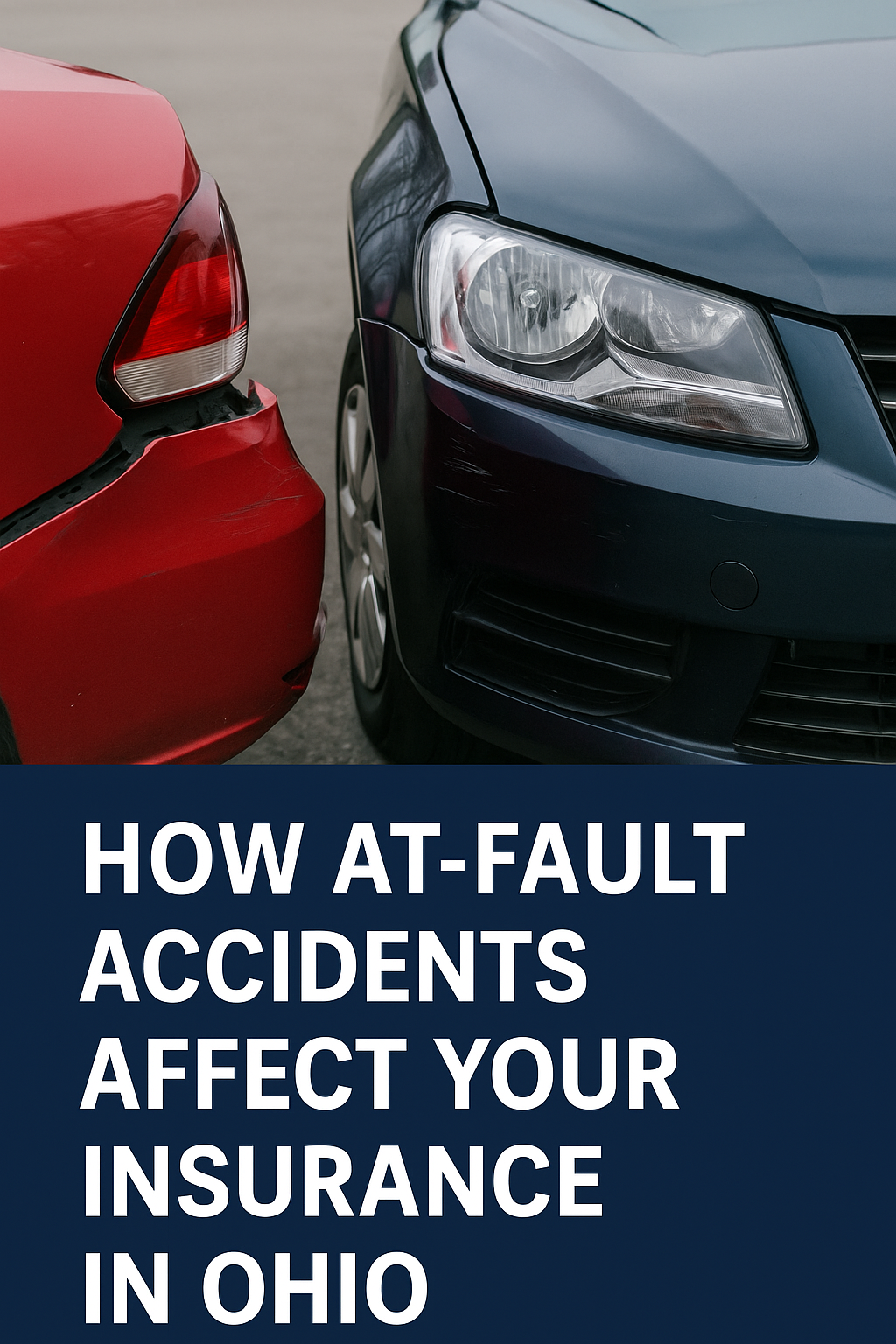
In Ohio, determining fault after an accident is not merely a matter of opinion; it is a structured decision based on evidence, legal definitions, and the insurer’s obligation to pay claims. An accident is considered at-fault when the driver’s actions or negligence directly contribute to the event. This may include failing to maintain assured clear distance, improper lane changes, left-turn conflicts, speeding, or losing control of the vehicle due to inattention. The extent of fault does not need to be absolute. Even partial fault often results in a surcharge, because insurers evaluate responsibility relative to the driver’s ability to prevent the loss.
In high-density traffic areas such as downtown Dayton, suburban Kettering, or the commercial corridors of Centerville, claims adjusters analyze intersections, road design, and vehicle movement patterns to determine which driver’s behavior most significantly contributed to the collision. Ohio’s comparative negligence laws allow multiple drivers to share fault, but insurers still treat any degree of meaningful responsibility as grounds for rating adjustments.
How Insurers Calculate Surcharges After an At-Fault Accident
When an Ohio driver is involved in an at-fault accident, the insurer evaluates both the severity of the claim and the risk implications for future driving behavior. The surcharge structure is based on actuarial evidence that drivers who cause one accident are statistically more likely to be involved in another within several years. While this correlation does not necessarily reflect a driver’s character or intention, it is a persistent trend across decades of insurance data.
Most carriers in Ohio apply a surcharge for at least three policy periods, often lasting three to five years depending on the company and the severity of the accident. A minor collision in Kettering may carry a lower surcharge than a major accident on I-75 in Dayton, but both can influence the overall rating tier assigned to the driver. The tiered rating structure used by carriers is one of the most significant elements determining premium cost. Even if the dollar amount of the surcharge appears modest, falling out of a preferred or ultra-preferred tier can create substantial increases because the driver is no longer qualifying for the top-level pricing benefits. If your accident resulted in a suspension of your license, read this guide about Ohio SR-22 Insurance.
The Role of Severity in Surcharge Levels
The financial impact of an at-fault accident is not uniform. Insurers categorize accidents based on severity, measured by the total payout required to repair vehicles, compensate injured parties, or address property damage. A low-severity accident, such as a minor scrape in a neighborhood near Centerville, may trigger a relatively small surcharge. A high-severity accident involving bodily injury or major property damage produces a significantly larger premium increase. In some cases, multiple coverages may come into play, including bodily injury, property damage, collision, and medical payments, each adding complexity to the settlement and increasing the long-term cost to the insurer.
Insurers also distinguish between accidents that involve structural impacts, rollovers, high-speed collisions, or multi-car involvement. These events are more likely to produce bodily injury claims, and bodily injury is among the most expensive categories of auto insurance losses. Settlements involving emergency care, imaging, rehabilitation, or long-term therapy drive claim expenses higher, and these costs directly influence the surcharge applied to the at-fault driver.
How Ohio’s Legal and Regulatory Environment Impacts Surcharges
Ohio’s Department of Insurance regulates how insurers may structure rating systems. While carriers have significant flexibility in designing their underwriting algorithms, they must present actuarially justified reasons for their surcharges. Ohio remains a relatively favorable regulatory environment for insurers, but it is also consumer-friendly in the sense that companies must file clear guidelines explaining when and how surcharges are applied.
What matters for drivers is that Ohio law places no strict limits on the amount insurers can increase premiums following an at-fault accident, as long as the rate filing is approved. This means a driver in Dayton or Kettering may experience a substantial increase after a major accident, particularly if the event triggers a loss of preferred-rating status. Carriers must also follow specific procedures regarding non-renewals, but premium increases are far more common than non-renewals after a first accident.
Why Even a Single At-Fault Accident Can Increase Premiums Significantly
Drivers are often surprised at how dramatically their premiums increase after a single at-fault collision, especially if they have spent decades with clean records. Much of this surprise stems from misunderstanding how underwriting tiers operate. The most favorable pricing tiers are reserved for drivers with the lowest expected future loss potential. A single at-fault accident can shift a driver from a preferred tier to a standard tier, resulting in a compounding effect where not only the surcharge itself but the loss of tier-based discounts increases the overall premium.
Consider a hypothetical driver with a long history of safe driving in Centerville. After a single at-fault accident, their insurer may apply a surcharge of several hundred dollars. But the larger impact comes from the removal of preferred-tier discounts, multi-year longevity benefits, or accident-free reductions that were previously earned. The combined effect often produces a premium increase that feels disproportionate to the severity of the accident, even though the insurer is simply aligning the policy with actuarial risk.
The Relationship Between Accident Frequency and Future Risk
The insurance industry’s belief that a single at-fault accident predicts higher future risk is not arbitrary. Decades of statistical analysis show clear correlations between one collision and the likelihood of subsequent collisions. Although individual drivers may strongly disagree with this concept, arguing that the event was isolated or uncharacteristic, insurers price risk based on large-scale probability rather than personal narratives.
This does not mean insurers assume a driver is reckless after a single accident. Instead, the data indicates that the factors leading to one collision—whether timing, distraction, misjudgment, or road conditions—are statistically likely to recur under similar circumstances. Even controlled studies involving experienced drivers show increased accident probability after an initial loss event. From an underwriting perspective, the surcharge is an adjustment to reflect measurable risk rather than a penalty imposed for wrongdoing.
How Long an At-Fault Accident Affects Rates in Ohio
Most Ohio carriers apply surcharges for three policy terms, typically equating to three years. Some companies extend the surcharge to four or five years for high-severity losses. The duration depends on the carrier’s internal loss modeling, as well as the type of coverage impacted. Collision losses generally fall off more quickly than bodily injury claims, which may remain in underwriting evaluations longer due to their cost implications.
Drivers in Dayton or Kettering who experience an at-fault accident during a premium cycle should expect to see the surcharge applied at the next renewal. Insurers typically do not apply mid-term adjustments for these events unless the accident materially changes coverage eligibility. Over time, as the accident ages, its impact diminishes until the surcharge eventually disappears. Maintaining a clean record during the surcharge period is essential because additional violations or accidents can trigger nonlinear premium increases, as drivers move deeper into high-risk tiers.
How an At-Fault Accident Impacts Other Drivers in the Household
An often-overlooked consequence of an at-fault accident is its effect on the entire household’s rating structure. Auto insurance in Ohio is priced based on driver-specific factors but also on household risk. If a teen driver in Centerville or a young adult in Dayton causes an accident, the household may lose certain tier privileges or multi-driver discounts tied to accident-free status. Even if other drivers have clean records, shared policy structures mean the overall premium increases because the household is treated as a cohesive risk unit.
Families in Montgomery County frequently encounter this scenario when a teen or young adult obtains their first probationary license. The combination of youthful inexperience and higher incident rates can shift a household into a tier where prices rise across all vehicles. This is why many families continue to practice supervised driving even after a teen receives their license, reinforcing safe habits and reducing the likelihood of a costly mistake that impacts the entire household financially.
Steps Ohio Drivers Can Take to Reduce the Financial Impact After an At-Fault Accident
While the surcharge itself may be unavoidable, drivers still have several strategic options to limit long-term premium impact. Maintaining a clean driving record after the accident is the most critical step. Avoiding additional violations ensures that the driver will eventually return to the preferred-tier pricing they previously enjoyed. Evaluating vehicle choice is also important; operating a moderately valued vehicle with strong safety ratings can significantly reduce collision and comprehensive premiums.
Bundling home and auto insurance remains one of the most effective ways to offset the cost of an at-fault accident. Drivers in Dayton, Kettering, and Centerville benefit disproportionately from bundling because their home insurance profiles often qualify them for additional multi-policy savings. Participating in telematics programs may also provide meaningful savings if the driver’s habits align with safe behavior patterns. Likewise, reviewing optional coverages with an independent agent helps identify opportunities to streamline the policy, ensuring the household maintains strong protections while avoiding unnecessary costs.
Interior Restoration Considerations After Garage-Impact Accidents: Color & Style Dayton
Many at-fault accidents do not occur on public roads at all. A surprising number involve garage collisions, structural impacts, and accidental property damage in or near the home. These incidents can damage garage walls, utility rooms, storage areas, and interior flooring. When a vehicle impact affects the home’s interior spaces, homeowners must coordinate the auto claim with their home insurance policy, creating a more complex restoration process.

Color & Style Dayton provides cabinetry, flooring, countertops, and interior design support that helps homeowners restore interior spaces after accidental impacts. Their expertise is particularly valuable when the damaged area must be matched with existing finishes or when homeowners choose to upgrade materials during the repair process. Winter months often create an ideal window for interior restoration, and partnering with experienced professionals ensures a smooth and high-quality result.
Preparing for the Future of Auto Insurance After an Accident
Drivers recovering from an at-fault accident often worry about future costs. The best approach is to treat the surcharge period as a temporary phase rather than a permanent penalty. Drivers who maintain clean records, avoid distractions, and exercise caution during high-risk periods such as winter months often see their rates stabilize and eventually decline as the accident ages out. Reviewing coverage annually with an independent agent helps identify when the market opens new opportunities for lower pricing or carrier transitions.
Conclusion: Navigating At-Fault Accident Consequences with Confidence
At-fault accidents create financial and emotional stress for Ohio drivers, but understanding how insurers evaluate these events brings clarity to a process that often feels opaque. Drivers in Dayton, Kettering, Centerville, and the broader Montgomery County region benefit from knowing how surcharges work, how long they last, and what proactive steps can help restore favorable pricing. Although the period following an accident may feel challenging, drivers who maintain strong driving habits and stay informed about their coverage options position themselves for long-term success.
Get Help Navigating Your Policy After an Accident
Ingram Insurance is an independent agency based in Dayton and serving drivers across Ohio. If you have been involved in an at-fault accident and want guidance on how it affects your policy, premiums, or long-term insurance strategy, our team is available to assist.
Ingram Insurance – Dayton’s Trusted Independent Agency
Address: 733 Salem Ave, Dayton, OH
Phone: (937) 741-5100
Website: www.insuredbyingram.com
Email: contact@insuredbyingram.com