Quick Navigation: Dry Cleaning Insurance 2026 Guide
Section 1: The 2026 Risk Landscape – Why “Standard” Plans Are Now Obsolete
The dry cleaning industry in 2026 is undergoing its most radical transformation in decades. What was once a stationary, chemical-heavy retail operation has evolved into a high-tech service hub driven by eco-friendly solvents, automated “smart” machinery, and app-based pickup and delivery models.
If your insurance strategy hasn’t evolved alongside these changes, your business is likely exposed to “legacy gaps”—coverage failures that occur when 2026 risks meet 2016-era policy language.
The 2026 Regulatory Pivot: The PCE Phase-Out
The most immediate threat to traditional dry cleaning operations is the shift in environmental regulation. In late 2024, the EPA finalized a landmark rule under the Toxic Substances Control Act (TSCA) to address the health risks of Perchloroethylene (PCE).
- Prohibition on New Equipment: As of June 16, 2025, the use of PCE in newly acquired dry cleaning machines is strictly prohibited.
- Residential Bans: By early 2026, most jurisdictions have accelerated the removal of PCE machines from mixed-use buildings (those containing residential units) to eliminate long-term exposure risks.
- The Insurance Impact: For cleaners still using PCE, “Environmental Liability” is no longer a luxury—it is a survival requirement. Underwriters in 2026 are increasingly hesitant to cover facilities using 3rd-generation PCE machines, often requiring “Workplace Chemical Protection Programs” just to qualify for a quote.
The Rise of the “Digital Cleaner” and Cyber Exposure
In 2026, over 60% of successful dry cleaners operate via a “hybrid model,” combining a retail storefront with tech-enabled pickup and delivery. This digital shift has introduced a risk profile that didn’t exist a decade ago:
- Data Vulnerability: Modern shops store vast amounts of sensitive customer data—including credit card info, home access codes, and contact details—within cloud-based POS systems.
- Targeted Phishing: Retail is now a primary target for cybercriminals, with phishing accounting for 65% of all successful breaches in 2025.
- Ransomware Paralysis: For an SMB cleaner, a ransomware attack is existential. If your automated sorting system or delivery app is locked, your revenue stops instantly while your “double extortion” liability begins.
The Labor Crisis and Operational Risk
The 2026 labor market is defined by a “skills mismatch” in technical maintenance roles. This labor shortage directly impacts your risk of loss:
- Maintenance Gaps: Without skilled technicians to service high-tech, AI-powered cleaning machines, businesses are seeing a spike in “Equipment Breakdown” claims caused by inadequate or delayed repairs.
- Workers’ Comp Pressure: Higher employee turnover means more inexperienced workers are operating high-heat pressing equipment and handling next-gen solvents, leading to elevated Workers’ Compensation exposure.
Social Inflation and the “Cost of Doing Business”
Finally, the financial scale of claims has shifted. Due to “social inflation”—the trend of rising jury awards—a “slip and fall” claim that might have settled for $50,000 in previous years now frequently exceeds $150,000 in 2026.
Standard $1 million General Liability limits, once considered the “gold standard,” are often insufficient for modern lease requirements and the realities of 2026 litigation.
Section 2: The “Big Four” Essentials – Modernizing Your Core Coverage
In the 2026 insurance market, “basic” coverage is no longer enough to protect a dry cleaning operation from modern financial threats. To build a resilient business, you must look beyond standard off-the-shelf policies and ensure your “Big Four”—General Liability, Bailee’s, Property, and Workers’ Comp—are optimized for today’s specific risks.
1. General Liability: More Than Just “Slip and Fall”
In 2026, General Liability (GL) remains the foundation of your insurance portfolio, typically costing between $40 and $85 per month for standard retail shops. However, the scope of what this policy must cover has expanded.
- Premises Liability: While the classic “slip and fall” in your lobby is still covered, 2026 policies must account for higher settlement costs due to “social inflation”. Standard limits are now shifting toward $1 million per occurrence and $2 million aggregate as a baseline requirement for most commercial leases.
- Advertising Injury: As dry cleaners move toward digital marketing and social media, the risk of libel, slander, or copyright infringement in your ads has skyrocketed. Your GL policy must include robust protection for these “personal and advertising injury” claims.
- Products-Completed Operations: If you sell specialized garment care products or offer minor tailoring and repair services, this coverage protects you if a product or service causes bodily injury or property damage after the customer leaves your shop.
2. Bailee’s Customer Insurance: The Dry Cleaner’s Lifeblood
The most common mistake dry cleaners make is assuming their General Liability policy covers the clothes in their shop. It does not. Standard GL policies exclude “property in your care, custody, or control”. For that, you need Bailee’s Customer Insurance.
- The “Unlimited” Standard: In 2026, many specialized insurers offer “Unlimited Bailee“ coverage. Without this, you are forced to guess the total value of every garment in your shop at any given time—a dangerous game if a fire occurs during a peak season like wedding or prom month.
- Care, Custody, and Control: This coverage triggers the moment a customer hands you a garment and remains in effect while the item is on your premises, in your delivery vehicle, or even stored off-site.
- Mysterious Disappearance: A critical 2026 add-on, this covers you when an item simply “goes missing” without evidence of theft or fire—protecting your reputation and your bottom line when a high-value designer piece is misplaced.
3. Commercial Property & Equipment Breakdown
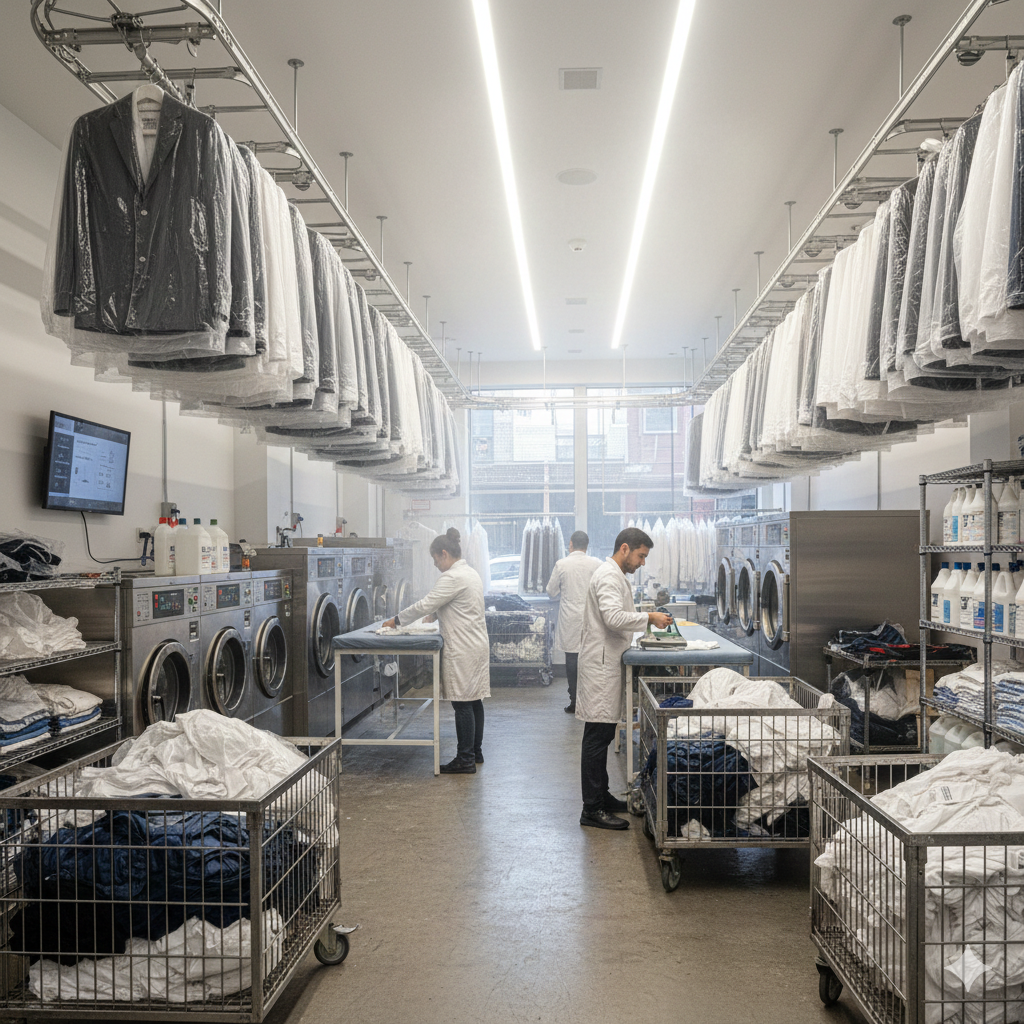
Your machinery is the heart of your plant. In 2026, the cost of high-tech, automated cleaning systems has made traditional property limits obsolete.
- Replacement Cost vs. Actual Cash Value: Ensure your policy is set to Replacement Cost. If a 2024-model machine is destroyed in 2026, you want the funds to buy a brand-new equivalent, not a depreciated payout that leaves you $50,000 short.
- Equipment Breakdown (Boiler & Machinery): Standard property insurance covers external threats like fire or wind. It does not cover internal failures like a boiler explosion, electrical arcing, or a computer system crash in your automated sorter. Equipment breakdown coverage is essential to pay for both repairs and the “Business Income” lost while your shop is dark.
- Spontaneous Combustion: Many 2026 property policies now require a specific endorsement for fires caused by spontaneous combustion—a known risk when oily or chemical-laden linens are folded while still warm.
4. Workers’ Compensation: Protecting Your Team in 2026
With 2026 rates seeing proposed increases in many regions (such as a 4.9% hike in some states), managing your Workers’ Comp is a financial necessity.
- Chemical Exposure & Respiratory Risks: Beyond burns and lifting injuries, 2026 underwriting focuses heavily on long-term respiratory health related to solvent exposure.
- Experience Modifier (E-Mod) Management: Your “E-Mod” score is the multiplier that determines your premium. In 2026, businesses with proactive “Return-to-Work” programs and OSHA-compliant safety training can lower their costs by up to 20% compared to those who are reactive.
- Mental Health & Trauma: A new trend for 2026 is the inclusion of mental health and trauma-related claims in many state-level Workers’ Comp mandates. Your policy must be broad enough to address the evolving definition of “workplace injury”.
The 2026 “BOP” Advantage
For small to mid-sized dry cleaners, bundling these into a Business Owner’s Policy (BOP) is often the most cost-effective move. A BOP typically combines General Liability, Commercial Property, and Business Interruption into one package, often starting around $925 per year for small retail locations—a significant discount over buying them separately.
Section 3: The Hidden Clauses – Environmental Liability, Cyber, and Spontaneous Combustion
In 2026, the difference between a business that recovers from a disaster and one that closes permanently often comes down to the “hidden clauses” in their insurance policy. While standard coverage handles the obvious, specialized endorsements are required for the silent killers of dry cleaning operations: environmental contamination, digital breaches, and the physical phenomenon of spontaneous combustion.
1. Environmental Liability: Navigating the PCE Phase-Out
Environmental liability has shifted from a “bonus” coverage to a non-negotiable requirement for 2026 dry cleaners. This is driven by the EPA’s finalized phase-out of Perchloroethylene (PCE) and a tightening regulatory framework around soil and groundwater contamination.
- The “Discovery” Trap: Many business owners mistakenly believe their General Liability policy covers pollution. In reality, most base policies contain an “absolute pollution exclusion”. Without a specific Pollution Liability Endorsement, you are 100% responsible for cleanup costs that can easily reach hundreds of thousands of dollars.
- On-Site vs. Off-Site Cleanup: Modern 2026 policies must cover both. If a solvent leak migrates to a neighboring property or into the local water table, you are liable for third-party property damage and remediation.
- PFAS and “Forever Chemicals”: 2026 is seeing increased scrutiny of per- and polyfluoroalkyl substances (PFAS). If your shop uses specialized water-repellent treatments, ensure your environmental clause doesn’t exclude these emerging contaminants.
2. Cyber Liability: Protecting the Digital Storefront
In 2026, dry cleaners are as much “tech companies” as they are garment experts. With the rise of app-based pickup/delivery and cloud-based POS systems, your digital risk is at an all-time high.
- The Human Factor: 60% of all data breaches in 2026 involve a “human element,” such as a staff member clicking a phishing link or misconfiguring a database.
- Cost of a Breach: For a small business, a cyber incident now carries an average cost of roughly $79,000 to $115,000. This includes forensic investigations, customer notification (which is legally mandated in most states), and potential regulatory fines.
- Ransomware and Business Interruption: If a hacker locks your automated sorting system or your customer database, your business stops. A 2026 Cyber policy must include Digital Business Interruption to replace lost income while your systems are being restored.
3. Spontaneous Combustion: The Invisible Fire Hazard
One of the most frequent—and misunderstood—causes of fire in the garment industry is spontaneous combustion. This occurs when materials heat up due to internal chemical reactions (oxidation) without an external flame.
- The “Oily Rag” Risk: Cotton towels or linens contaminated with vegetable, massage, or industrial oils are highly prone to self-heating. Even after washing, residual oils can remain if water temperatures weren’t high enough.
- The Cooling Cycle Trap: Fires often start hours after a shop has closed. If warm laundry is folded or stacked too tightly while still hot from the dryer, the trapped heat can reach ignition temperature.
- Insurance Implications: Many standard fire policies in 2026 require businesses to prove they follow Standard Operating Procedures (SOPs)—such as a mandatory “cool down” cycle in dryers and the use of metal bins for soiled rags—to honor a claim. If your policy lacks a specific “Spontaneous Combustion Clause,” a carrier may argue negligence if a fire starts in a pile of hot linens.
4. Summary of “Silent” Risk Protection
To be fully protected in 2026, your WordPress page should emphasize that these three areas require specific attention during an annual review:
| Risk Type | The Threat (2026 Landscape) | Key Policy Requirement |
|---|---|---|
| Environmental | PCE leaks, soil contamination, and new PFAS “forever chemical” regulations. | Pollution Liability (On-site & Off-site Remediation) |
| Cyber | Data theft of customer payment info; Ransomware locking automated sorting systems. | Cyber Liability & Data Breach Response Rider |
| Combustion | Chemical oxidation and trapped heat in folded linens leading to overnight fires. | Spontaneous Combustion Clause / Fire Endorsement |
Section 4: Cost Breakdown – How Premiums are Calculated in 2026
In 2026, the cost of insuring a dry cleaning business is no longer a “flat fee” based on shop size. Instead, insurance carriers are using sophisticated data modeling—including AI-driven risk scoring and real-time economic data—to determine your rates.
For most small to mid-sized dry cleaners, a comprehensive insurance package in 2026 typically ranges from $2,500 to $5,500 annually, though this can vary significantly based on your specific operation.
1. Estimated Premium Ranges by Coverage Type
Understanding the individual “building blocks” of your premium helps you budget more effectively. Based on 2026 market data, here are the median monthly costs for the essential policies:
| Policy Type | Est. Monthly Premium (2026) | Primary Cost Driver |
|---|---|---|
| General Liability | $45 – $115 | Annual revenue, location, and foot traffic |
| Bailee’s Customer | $30 – $75 | Total value of garments held on-premises |
| Workers’ Comp | $120 – $450 | Total payroll and state-specific risk rates |
| Cyber Liability | $8 – $25 | Security protocols (MFA, encryption) and data volume |
| Commercial Auto | $100 – $200 | Vehicle count, usage radius, and driver records |
2. The “Risk Quality” Factor in 2026
Underwriters in 2026 are focusing heavily on “Risk Quality.” Two identical shops in the same city may pay vastly different premiums based on their safety protocols.
- The EPA Compliance Credit: Shops that have documented their transition away from PCE (Perchloroethylene) to greener solvents like liquid CO2 often see “environmental safety” discounts.
- Building Resilience: If your shop is in a high-hazard zone for wildfires or floods, insurers now use aerial imagery and GIS data to score your building’s defense. Investing in “home-hardening” or flood barriers can lower property premiums by up to 15%.
- Telematics for Delivery: If you offer pickup and delivery, installing telematics (GPS tracking that monitors speed and braking) in your vans can secure lower commercial auto rates in an otherwise “firm” 2026 market.
3. Economic Drivers of 2026 Rates
Several external forces are pressuring insurance costs this year:
- Medical Inflation: Because Workers’ Comp and General Liability often pay for medical treatments, the 9% projected rise in healthcare costs for 2026 is pushing premiums upward.
- Equipment Replacement Costs: The cost of specialized cleaning machinery and parts remains high due to 2026 tariffs on imported steel and aluminum. Since your “Replacement Cost” coverage must track these prices, property premiums have adjusted accordingly.
- Social Inflation: Higher jury awards for personal injury claims have forced carriers to raise the base rates for liability coverage across all retail sectors, including garment care.
4. How to Lower Your 2026 Premiums
You aren’t powerless against rising costs. Strategic shifts can significantly impact your bottom line:
- Opt for a BOP: Bundling General Liability, Property, and Business Interruption into a Business Owner’s Policy (BOP) remains the most cost-effective move, often saving cleaners 15-20% compared to standalone policies.
- Increase Your Deductible: Moving from a $500 to a $2,500 deductible can reduce your annual premium by a meaningful percentage—just ensure your business has the cash reserves to cover that “worst-case” out-of-pocket cost.
- Document Everything: Carriers in 2026 reward “organized submissions.” Having a clear, written safety manual, a “cool-down” protocol for dryers (to prevent spontaneous combustion), and an incident response plan for cyber events makes your business much more attractive to top-tier insurers.
Section 5: The Ultimate Checklist – 5 Questions to Ask Your Agent Before Your 2026 Renewal
As you prepare for your 2026 insurance renewal, you should not treat it as a passive “check-the-box” activity. Business operations in the garment care industry evolve rapidly—you may have added new delivery routes, upgraded to AI-driven machinery, or phased out older solvents like PCE.
Before you sign your next policy, sit down with your agent and ask these five critical questions to ensure you are not overpaying for obsolete coverage or leaving your assets exposed to modern 2026 risks.
2026 Renewal Checklist
- Verify Solvent Compliance: Does my pollution policy match my current solvent use?
- Audit Equipment Values: Have property limits been adjusted for 2026 replacement costs?
- Test Cyber Coverage: Does my policy cover “Business Interruption” from a digital outage?
- Confirm Bailee’s Scope: Are garments covered in my delivery vans and for “mysterious disappearance”?
- Review Workers’ Comp: Is my E-Mod score accurate based on my current staff size?
1. “Has my policy been updated to reflect the 2024 EPA Perchloroethylene (PCE) phase-out?”
With the EPA’s finalized phase-out of PCE, your environmental liability and property coverage must be aligned with current regulations.
- The Transition: If you have moved to “green” solvents, ask if you qualify for an environmental safety discount.
- The Risk: If you are still using PCE, verify if your pollution liability limits are still adequate or if your carrier has added new restrictive exclusions for mixed-use buildings.
2. “Does my Bailee’s coverage include ‘Mysterious Disappearance’ and ‘In-Transit’ protection?”
In 2026, a dry cleaner’s risk extends far beyond the four walls of their shop.
- In-Transit: If you offer pickup and delivery, your Bailee’s policy must explicitly cover customer garments while they are in your van.
- Mysterious Disappearance: Ask if you are covered if a high-value item simply goes missing from your inventory without evidence of a break-in—a common point of friction with standard policies.
3. “Is my Equipment Breakdown coverage set to ‘Replacement Cost’ for 2026 machinery prices?”
The cost of modern cleaning technology has risen significantly due to 2026 economic conditions.
- Valuation: Ensure your equipment is covered for its Replacement Cost rather than its “Actual Cash Value” (which subtracts depreciation).
- Complexity: Ask specifically if your policy covers the sensitive computerized control units and automated sorting systems that are now standard in high-volume plants.
4. “How does our digital security impact our Cyber Liability premium?”
By 2026, most carriers have moved to a “risk-based” pricing model for cyber insurance.
- Discounts: Ask if implementing Multi-Factor Authentication (MFA) or encrypted backups for your customer database will trigger a lower premium.
- Scope: Ensure the policy covers not just data breaches, but also Digital Business Interruption if a ransomware attack locks your POS or delivery app.
5. “Are there new bundling options or ‘Green Solvent’ credits available this year?”
Insurers frequently update their discount offerings to match industry shifts.
- Bundling: Ask about a Business Owner’s Policy (BOP), which often provides the best value by packaging General Liability, Property, and Business Interruption.
- Safety Credits: If you have implemented new employee safety training or a formal “Return-to-Work” program, verify that these are being credited toward your Workers’ Compensation rates.